Why Your Foot Hurts When Running (And What To Do About It) – Boston
- Jordan Metcalf

- Jan 11
- 7 min read
If anyone is familiar with a sharp pain in the foot when out for a run…

It’s me.
I remember the exact moment at the beginning of 2025 that I went out for a run, and knew within 3 minutes of starting that I was in trouble. I’m no stranger to injuries, so I have a pretty good sense of what I can push through and what’s going to get me in hot water. And let me tell you, my foot was boiling.
What was wild to me though, was that even with my level of expertise, a foot specialist physical therapist, and a visit to an orthopedic PA at Massachusetts General Hospital, my rather serious foot injury got missed.
Why?
Because I didn’t get in front of the right pair of eyes. Having access to the best information and the right expert makes all the difference, because even the least serious foot injuries that runners face can keep you sidelined for months.
So, let’s arm you with the best information about why your foot might hurt when running, how to tell the difference between something you can manage and something that needs professional attention, and what steps you can take right now to get back to running pain free.
Translating Your Foot Pain Into “Medical” Terms



That sharp pain under your heel first thing in the morning that warms up throughout the day.
This is likely plantar fasciitis, which is an irritation of the thick band of tissue that runs along the bottom of your foot. This type of pain might feel worse first thing in the morning and warm up throughout the day, and could also be irritated by wearing shoes that have a toe that “swooshes” upwards or a shoe that isn’t supportive (like converse all stars).
Plantar fasciitis can range from mild to severe, but generally responds well to rehab including exercise, stretching, footwear modification, and dry needling. [1,2] This injury may not require you to stop running completely, but you may need to adjust your training to accommodate your recovery.
Your forefoot feels bruised after every run, and your feet are super sensitive to shoes with a narrow toe box.
This sounds like an injury to the metatarsals (the long bones of the foot). This can range from mild metatarsalgia that improves with footwear adjustments and scaled back training, to a metatarsal stress fracture that requires medical attention. Metatarsal stress fractures are common in distance runners, so doctors and physical therapists who specialize in working with these folks will be more likely to catch one.
Your foot hurts right at the spot where your laces tie, it doesn’t warm up, and sometimes it hurts to walk or stand for a while.
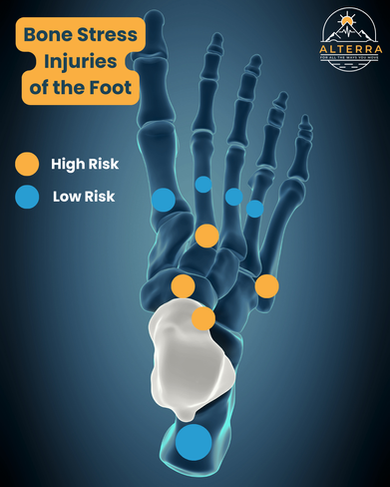
If pain develops in this area that goes away completely and quickly, you may have just had your shoes tied too tightly. If it lingers, it may be a quite serious bone stress injury of the navicular bone. This is the bone that I injured in my story at the beginning of this post, so I’m very familiar with what this feels like. If you're a runner with pain on the top of your foot that hurts with walking, hopping, running, and is tender to touch, you need to see a medical professional as soon as possible. The worst cases of these injuries require surgery and have potentially long term consequences. Not to mention that they often take 6 months to diagnose correctly because of how often they get missed (which is exactly how long mine took to get diagnosed). [3]
In other words…don’t guess. Get it checked out. Learn more about stress fractures in the foot from running.
Every time you land you feel a sharp pain on the inside of your ankle right behind your ankle bone.
This sounds like posterior tibialis tendinopathy– an injury to the tendon that supports the arch of your foot when you run. This type of pain might feel worse when your foot accepts the full weight of your body, might warm up slightly with activity, and often feels better in more supportive shoes. This injury usually responds best to a multi-pronged approach including footwear modification, foot joint mobilization exercises, and stabilization exercises to help take some of the pressure off of the healing tissue while building its capacity back up. [4]
You have pain in the achilles tendon area.
This type of pain is super common, but there are 3-4 different reasons why it may happen. I’ve written a free e-book about the different types of achilles tendon pain, so if this is what you’re dealing with, download my free Runners Guide To Achilles Tendon Pain to get a thorough answer.
The outside of your foot hurts, especially when you either push off over your big toe OR walk on the outside of your foot.
This could be two different things. The first is peroneal tendinopathy, which is an injury to the tendon on the outside of your ankle that stabilizes your foot when you push off. This can cause pain near the outside of the ankle OR the outside of the foot. However, sometimes pain on the outside of the foot in front of the bony part of the ankle can be a symptom of what’s called a 5th metatarsal stress fracture or a Jones fracture. These are typically more sensitive to putting pressure on the outside of the foot while walking, standing, or running, and rarely warm up as you go. Sometimes, running can be continued while working through peroneal tendinopathy, but a 5th metatarsal stress fracture requires urgent medical attention and management.
Unfortunately, foot pain doesn't always fit perfectly into a pattern. When I had my bone stress injury, my symptoms were sometimes misleading.
Sometimes, my foot pain warmed up a bit.
My symptoms weren't exactly on the bone that was injured.
I remember doing a single leg hop in the doctor's office right before I went non-weightbearing for 6 weeks...it didn't hurt.
All that to say, again…don’t guess, get it checked out.
The Running Factors That Contribute to Foot Pain
Most running factors that contribute to foot pain are the usual suspects [5]:
Sharp spikes in training load
Especially big increases in long run distance week to week
Shoe wear and selection
Most running shoes are good for between 350-400 miles, carbon plated shoes closer to 150-200.
Using a shoe with the wrong support, shape, or heel to toe drop can all lead to pain and injury in the foot.
Form compensations from other injuries
Especially injuries to the foot and ankle that cause you to put more pressure on one side of your foot or limit your normal range of motion.
However, there are three running factors that I have found in my clinical experience have an especially big impact on the feet:
Running surface
Running on sand or soft surfaces puts extra stress on your foot and ankle muscles, especially your achilles. Your best bet? Flat, hard-packed dirt trails. Surfaces that are especially uneven may normally be fine for your foot and ankle, but if you are recovering from an injury you’ll want to keep to flat ground.
Running incline
Running uphill adds considerably more load to the foot and ankle complex compared to flat ground. If you’ve got a cranky achilles tendon, running the Newton hills will probably have to wait.
Running speed
Running faster can cause injuries to other parts of the lower body as well, but the feet are especially sensitive.
What To Do When Your Foot Hurts
The first thing you should do if your foot hurts when running…is talk to me, honestly. When I was struggling to figure out my foot pain, it was after a 15 minute call with one of my colleagues that I set off on the (finally) correct treatment course. While I can’t really diagnose over a zoom call, I can at least help you approach your pain with the right level of concern, and tell you whether you need to see your doctor or come in for an evaluation.
If you DON’T want to talk to me (no offense taken, though my mom tells me I’m a delight), here’s what I would do next:
Give yourself 3-4 weeks to see improvement. If you're doing the right things, your pain should start getting better in that timeframe.. That’s usually how quickly my patients start feeling better. You don’t have to get 100% better in that time period, but you should see some improvement. Otherwise, you might be chasing your tail doing the wrong things to get rid of your pain.
While your treatment strategy depends on what specific type of injury you’re dealing with, you can use this stoplight analogy to help you decide whether it’s safe to continue running:

Final Thoughts on Why Your Foot Hurts When Running
Figuring out why your foot hurts when running is the first step to figuring out how to fix it. But fixing it on your own can still be tricky. Foot injuries can be complex, and the consequences of missing a risky one can be severe. At Alterra, we specialize in running injuries, so if you’re a runner in Boston’s Back Bay dealing with foot pain, we’d love to help! Book a free discovery call to talk to a therapist today.
Disclaimer: The information in our blog posts is not a substitute for professional medical advice. Consult a healthcare provider before making decisions related to your health. Use our content at your own risk.
Sources
Thong-On S, Bovonsunthonchai S, Vachalathiti R, Intiravoranont W, Suwannarat S, Smith R. Effects of Strengthening and Stretching Exercises on the Temporospatial Gait Parameters in Patients With Plantar Fasciitis: A Randomized Controlled Trial. Ann Rehabil Med. 2019;43(6):662-676. doi:10.5535/arm.2019.43.6.662
Rhim, H.C.; Kwon, J.; Park, J.; Borg-Stein, J.; Tenforde, A.S. A Systematic Review of Systematic Reviews on the Epidemiology, Evaluation, and Treatment of Plantar Fasciitis. Life 2021, 11, 1287. https://doi.org/10.3390/life11121287
Patel, Karan A. MD; Christopher, Zachary K. MD; Drakos, Mark C. MD; O'Malley, Martin J. MD. Navicular Stress Fractures. Journal of the American Academy of Orthopaedic Surgeons 29(4):p 148-157, February 15, 2021. | DOI: 10.5435/JAAOS-D-20-00869
Kulig K, Lederhaus ES, Reischl S, Arya S, Bashford G. Effect of Eccentric Exercise Program for Early Tibialis Posterior Tendinopathy. Foot & Ankle International. 2009;30(9):877-885. doi:10.3113/FAI.2009.0877
Gijon-Nogueron, G., & Fernandez-Villarejo, M. (2015). Risk Factors and Protective Factors for Lower-Extremity Running Injuries: A Systematic Review. Journal of the American Podiatric Medical Association, 105(6), 532-540. Retrieved Jan 9, 2026, from https://doi.org/10.7547/14-069.1


_edited.png)


Comments